Top 5 Critical Mistakes SMEs Make When Selecting an ERP System for Manufacturing
- Framework Works
- May 4
- 6 min read
Updated: Jun 28
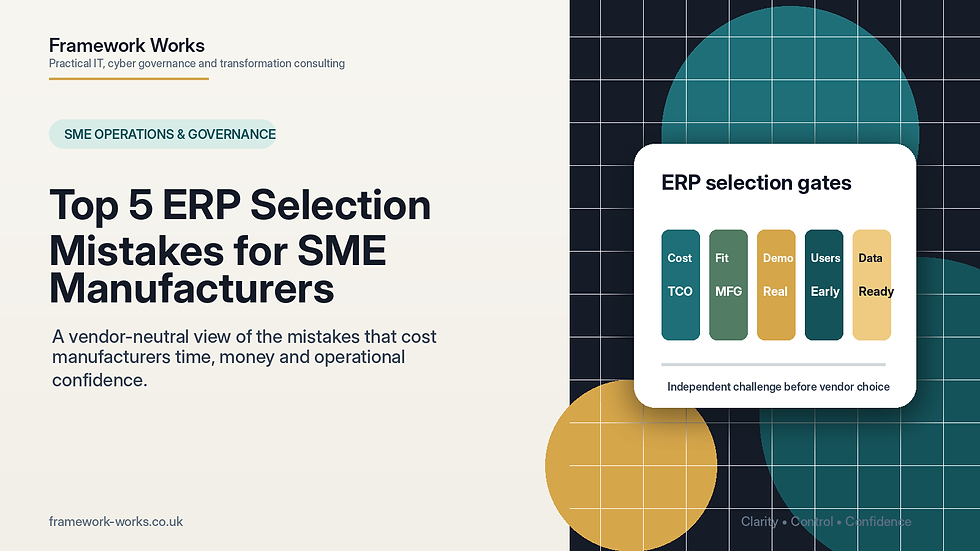
What are the biggest ERP selection mistakes for SME manufacturers?
The biggest ERP selection mistakes for SME manufacturers are choosing on price alone, selecting a generic system, relying too heavily on sales demos, excluding real users and underestimating data readiness. A successful ERP decision starts with clear requirements, honest preparation, user involvement and independent challenge before any vendor is selected.
ERP projects regularly fail to meet their original goals when requirements, data readiness, user involvement and implementation planning are underestimated. For small and mid-sized manufacturers without a dedicated IT team, that number creeps even higher. The system gets selected with the best intentions, the budget gets approved, and then somewhere between the sales demo and go-live, things fall apart.
The good news? Most of these failures are predictable. They follow the same patterns, made by the same types of businesses, for the same reasons. Here are the five most common mistakes SME manufacturers make when selecting an ERP system, and what to do instead.

Mistake 1: Choosing the Cheapest Option Without Understanding the True Cost
The initial licence price is just the beginning. Many SMEs focus on the headline number and miss everything underneath it: data migration, third-party integrations, user training, infrastructure upgrades, and ongoing support fees.
A system that looks affordable at £15,000 can easily reach £60,000 or more once you factor in the full implementation. Worse, if the system doesn't scale with your business, you're looking at replacing it within three to five years, paying those costs all over again.
Before committing to any vendor, ask for a full Total Cost of Ownership (TCO) breakdown across a three-year horizon. Request itemised quotes for implementation, training, support, and any add-on modules you'll need for manufacturing-specific functions like bill of materials (BOM) management or shop floor scheduling.
Mistake 2: Picking a Generic System That Wasn't Built for Manufacturing
A common shortcut is selecting a well-known, general-purpose ERP because the brand is familiar or the interface looks clean. The problem is that generic systems are built for broad use cases, not the specific demands of a production environment.
Manufacturing requires features that most off-the-shelf business software simply doesn't include as standard: multi-level bills of materials, work-in-progress (WIP) tracking, capacity planning, and shop floor data capture. Without these, your team ends up managing critical production processes in spreadsheets alongside the ERP, which defeats the entire purpose of the investment.
Look specifically for systems designed for, or with deep experience in, discrete or process manufacturing. Ask each vendor to walk you through how their system handles your most complex production scenario, not just a standard sales demo flow.
Mistake 3: Letting Sales Demos Drive the Decision
Vendor demos are polished. They're built to impress. Without an internal IT team to ask the hard technical questions, many SME buyers walk out of a demo feeling confident about a system that won't survive contact with their actual factory floor.
Sales teams will show you the best version of their product, using clean data, ideal scenarios, and pre-configured workflows. What they won't show you unprompted is how painful it is to migrate your existing data, what the system looks like when a custom report needs building, or how support responds when something breaks during month-end.
Counter this by preparing a list of your real business scenarios before any demo. Share actual production data and ask vendors to demonstrate against it. Request reference calls with existing manufacturing customers of a similar size, not enterprise case studies with budgets ten times yours.
Before committing to an ERP vendor, SME manufacturers should take time to define real business scenarios, clarify requirements and challenge assumptions made during sales demos.
Framework Works can support this through independent, vendor-neutral Consultancy Services focused on project readiness, requirements definition, governance and technology decision support: https://www.framework-works.co.uk/blank
If you are preparing for ERP selection internally, the Templates & Resources section includes practical tools such as business requirements, project charter, gap analysis, Gantt chart and risk register templates: https://www.framework-works.co.uk/blank-1
A useful supporting article is Why SMEs Need Governance Before They Need More Technology, because ERP success depends heavily on ownership, process clarity and operational readiness before the system is selected: https://www.framework-works.co.uk/post/why-smes-need-governance-before-they-need-more-technology
If you are currently evaluating ERP systems, questioning vendor claims or preparing for a system change, contact Framework Works for an independent conversation before decisions become expensive to reverse: https://www.framework-works.co.uk/contact
Choosing an ERP? Get Independent Challenge Before You Commit
ERP selection is too important to be driven by polished demos alone.
Before you commit to a vendor, Framework Works can help you challenge assumptions, test the system against real operational scenarios and make sure the decision is based on business need rather than sales presentation.
Our role is not to sell you software. It is to help you make a better, more informed decision.
Mistake 4: Excluding the People Who Will Actually Use the System
ERP selection is often handled by a business owner or finance lead. The people on the shop floor, the production managers, the warehouse operatives, the planners, are rarely involved until the system is already chosen and being rolled out.
This creates a fundamental disconnect. The system gets configured around how leadership thinks the business works, not how it actually operates day to day. The result is low user adoption. Workers find workarounds. Spreadsheets creep back in. The ERP becomes an expensive reporting tool that nobody trusts.
Bring your key users into the process early. Ask them what frustrates them about the current way of working. Have them sit in on vendor demos. Their practical knowledge will surface requirements that no manager or consultant would think to ask about, and their early involvement builds the buy-in that makes adoption stick.
Mistake 5: Underestimating What It Takes to Get Your Data Ready
Data migration is consistently cited as one of the top causes of ERP project delays, and it's almost always underestimated. Around 22% of businesses identify data migration as their single biggest implementation hurdle, but the actual impact is far broader than that number suggests.
Manufacturing data is messy by nature. Years of growth leave behind duplicate supplier records, inconsistent part numbers, inaccurate stock counts, and BOMs that haven't been updated since the original product engineer left. When that data is migrated into a new system without proper cleansing, you get what the industry calls "garbage in, garbage out." The system is live, but the data inside it can't be trusted.
Start your data audit before you've even selected a vendor. Map out what data you have, where it lives, and how clean it is. Build data preparation time into your project timeline as a non-negotiable phase, not an afterthought. Any vendor that tells you data migration is simple hasn't been honest with you.
The Common Thread Behind All Five Mistakes
Every one of these mistakes shares a root cause: SME manufacturers are being asked to make complex, high-stakes technology decisions without the internal expertise or independent guidance to navigate them well.
Vendors have a commercial interest in getting you to sign. Managed service providers often favour the systems they're already certified to support. Without someone in your corner whose only job is to find the right fit for your business, the deck is stacked against you.
That's exactly the gap a specialist ERP advisory service for SME manufacturers is built to fill. Not to sell you a system, not to implement a preferred vendor's software, but to help you ask the right questions, evaluate the right options, and avoid the mistakes that cost businesses time, money, and operational stability.
Getting ERP selection right the first time isn't luck. It's the result of a clear process, independent advice, and honest preparation. Start there, and the technology becomes the easy part.
Frequently Asked Questions About ERP Selection for SME Manufacturers
What should SME manufacturers consider before choosing an ERP system?
SME manufacturers should consider total cost, manufacturing-specific functionality, data readiness, user involvement, implementation support, reporting needs, integration requirements and how well the system fits real production processes rather than just the sales demo.
Why do ERP projects fail in manufacturing SMEs?
ERP projects often fail because the business selects a system before understanding its requirements, underestimates data migration, excludes key users, relies too heavily on vendor demos or chooses a generic system that does not support manufacturing processes properly.
What ERP features matter most for manufacturing businesses?
Important ERP features for manufacturers include bill of materials management, production planning, stock control, shop floor visibility, purchasing, quality control, traceability, work-in-progress tracking, reporting and integration with finance and operational systems.
Should SMEs get independent ERP advice before speaking to vendors?
Yes, independent ERP advice can help SMEs define requirements, challenge assumptions, prepare better demo scenarios, compare vendors objectively and avoid being guided mainly by sales messaging. This is especially useful where the business does not have a dedicated internal IT or transformation team.
Choosing an ERP system is too important to leave to sales demos alone. Framework Works provides independent, vendor-neutral ERP advisory support for SME manufacturers, helping you clarify requirements, challenge vendor claims and make a decision based on how your business actually operates.
ERP readiness is one part of a wider digital foundation. If your business is also reviewing how it presents itself online — including website clarity, customer trust and enquiry routes — BrightPath Digital can help with practical website audit and improvement support.
Ready to Get It Right First Time?
If you're an SME manufacturer currently evaluating ERP systems, or questioning a decision already in progress, we'd welcome the conversation. Our advisory work is independent, vendor-neutral, and focused entirely on finding the right fit for your business.
Get in touch to arrange a no-obligation introductory call. We'll listen to where you are, share an honest view of your options, and help you move forward with confidence.


Comments